
Home Valuations Can Be Complicated Sometimes
Which Appraisal Types are Best and Why?

Confused about Appraisal Types? It can be tricky figuring out which one is right and why.
In today’s evolving real estate market, not every property requires the same level of appraisal analysis. Advances in technology, expanded data availability, and changing lending standards have created multiple appraisal formats designed for different levels of risk, complexity, and intended use.
The three most common options are:
💻 Desktop Appraisals 🏡 Hybrid Appraisals 📋 Traditional Full Appraisals
Appraisal types serve different purposes, and understanding the differences can help homeowners, buyers, lenders, Realtors, and investors make smarter decisions.
As Certified Residential Real Estate Appraisers, we regularly help clients determine which appraisal solution best fits their situation while balancing speed, cost, accuracy, and risk.
Let’s break down the most important differences and when each option makes the most sense.
💻 Desktop Appraisals
Fast, Data-Driven, and Remote
A Desktop Appraisal is completed entirely from the appraiser’s office without physically visiting the property. The appraiser relies on:
- MLS data
- Public records
- Aerial imagery
- Floor plans
- Prior listing photos
- Market analytics
- Tax data
- Third-Party Information Sources
When Do Desktop Appraisals Work Best?
Desktop appraisals are commonly used for:
- Low-risk lending situations
- Home equity products
- Portfolio monitoring
- Refinances with strong prior data
- Properties in homogeneous subdivisions
- Situations requiring fast turnaround times
Key Limitations
Because no physical inspection occurs:
- Deferred maintenance may be missed
- Renovations may not be verified
- Condition quality may be overstated or understated
- External influences may not be fully observable
- Unique features can be overlooked
📌 Appraiser’s Tip: Desktop appraisals prioritize speed and efficiency, but they rely heavily on the accuracy of available data.
🏡 Hybrid Appraisals
A Middle Ground Between Speed and Verification
A Hybrid Appraisal combines:
- A third-party property inspection
- An appraiser’s remote valuation analysis
In this format:
- A trained inspector or data collector visits the property
- Photos, measurements, and condition details are gathered
- The licensed appraiser then analyzes the data remotely and develops the value opinion
When Do Hybrid Appraisals Make Sense?
Hybrid appraisals are often useful for:
- Moderate-risk lending scenarios
- Properties requiring quicker processing
- Markets with strong comparable sales data
- Situations where some physical verification is important
Key Limitations
The appraiser is still not personally inspecting the property, which means:
- Nuances in quality or craftsmanship may be missed
- Neighborhood influences may not be fully understood
- Certain functional issues may not be identified
- Complex properties may not fit this format well
📌 Appraiser’s Tip: Hybrid appraisals offer a balance between:
- Cost efficiency
- Faster turn times
- Some level of physical property verification
They reduce risk compared to desktop reports but still may not provide the depth of a full appraisal.
📋 Traditional Full Appraisals
The Most Comprehensive Valuation Method
A Traditional Full Appraisal involves:
- A licensed appraiser physically inspecting the property
- Interior and exterior analysis
- Neighborhood evaluation
- Comparable sales research
- Market trend analysis
- Condition and quality verification
This remains the gold standard for most complex valuation assignments.
When Are Full Appraisal Types Best?
Full appraisals are typically recommended for:
- Home purchases
- Complex or unique properties
- Waterfront homes
- Luxury homes
- Properties with extensive renovations
- Litigation or estate work
- Divorce settlements
- PMI removal disputes
- Investment analysis
- High-risk lending decisions
Trade-Offs
Full Appraisals generally:
- Cost more
- Take longer to complete
- Require property access and scheduling
However, they provide the highest level of reliability and customization.
📌 Appraiser’s Tip: Full appraisals provide the most complete understanding of:
- Property condition
- Marketability
- Location influences
- Buyer behavior
- Market-supported adjustments
Quick Comparison Guide
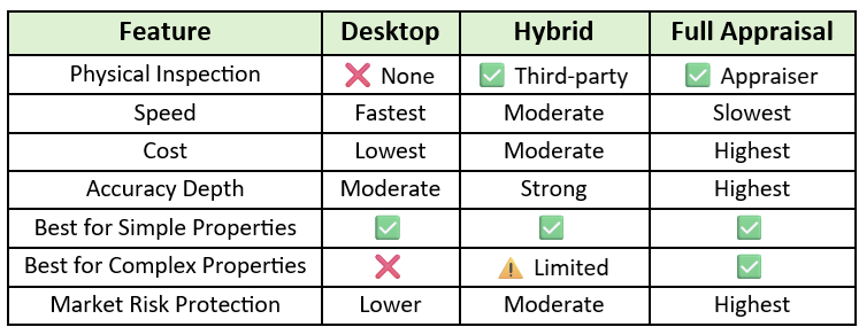
Why Is This Important?
Choosing the wrong appraisal format can create:
- Valuation gaps
- Lending delays
- Missed property features
- Inaccurate condition analysis
- Increased transaction risk
Not every property fits a streamlined process. For example:
- A cookie-cutter subdivision home may perform well with a desktop or hybrid appraisal.
- A waterfront property, custom-built home, rural property, or heavily renovated home often requires a full appraisal to properly measure market reaction and contributory value.
As we’ve discussed in prior newsletters, valuation accuracy often depends on understanding:
- Micro-location influences
- Condition differences
- External obsolescence
- Buyer behavior
- Risk exposure
- Market-supported adjustments
How Can You Maximize Your Property Value?
Understanding appraisal formats helps property owners prepare strategically.
Homeowners Can Improve Outcomes By:
✅ Documenting renovations and upgrades
✅ Providing permits and contractor invoices
✅ Maintaining the property prior to inspection
✅ Understanding which appraisal format their lender is using
✅ Highlighting market-supported features buyers value most
In higher-risk or more unique properties, requesting a full appraisal may help ensure:
- Important upgrades are recognized
- Condition is accurately measured
- Location premiums are fully analyzed
- External influences are properly considered
Why Hiring a Real Property Appraiser Matters
Automated systems and limited-scope reports can be useful tools, but they cannot fully replace the judgment, experience, and market interpretation of a licensed real property appraiser.
A professional appraiser:
- Interprets buyer behavior
- Analyzes comparable sales properly
- Identifies market-supported adjustments
- Understands local market nuances
- Recognizes risk factors automated systems may miss
At Redefine Value, we believe appraisal is not simply about filling out forms; it’s about interpreting how real buyers and sellers behave in real markets. The most accurate valuations come from:
- Local market expertise
- Physical observation
- Data analysis
- Professional judgment
- Experience across changing market conditions
That combination produces reporting tailored specifically to the property and the market surrounding it.
5 Practical Takeaways
Desktop Appraisals Prioritize Speed – Desktop appraisal types work best for low-risk, standardized properties where reliable data already exists. They are efficient but may miss important physical or locational details that impact value.
Hybrid Appraisals Balance Efficiency and Verification – Hybrid reports provide more reliability by including a third-party inspection while still reducing turnaround time and cost. They work well in moderate-risk lending scenarios but may not fully capture complex property characteristics.
Full Appraisals Deliver the Highest Accuracy – Traditional appraisals provide the most complete valuation analysis because the appraiser personally inspects the property and analyzes market behavior firsthand. They remain the preferred option for unique, luxury, waterfront, or high-risk properties.
Property Complexity Should Drive the Appraisal Choice – The more unique the property, the more important a full appraisal becomes. Homes with renovations, external influences, unusual layouts, or premium features require deeper analysis to avoid undervaluation or lending issues.
Licensed Appraisers Provide Market Insight Beyond Algorithms – Real estate valuation is not purely mathematical. Professional appraisers interpret buyer behavior, neighborhood trends, risk factors, and comparable sales in ways automated systems alone cannot fully replicate.