
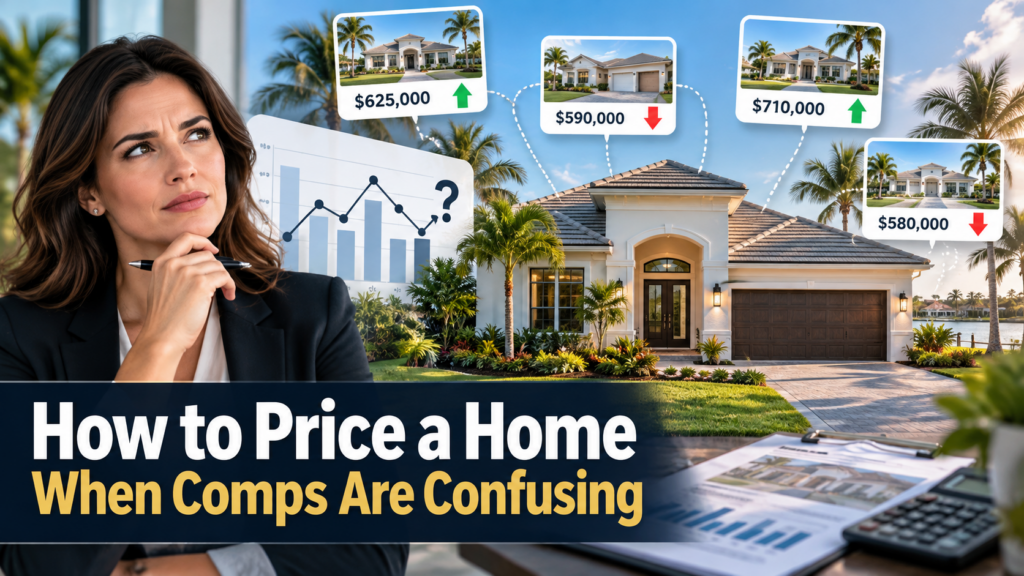
What Do You Do When Recent Sales, Active Listings, and Market Conditions Tell Different Stories?
“Comps,” or comparable properties, are homes that buyers would reasonably consider alternatives to the property being valued. But sometimes the evidence conflicts: one recent sale closed high, another sold low, active listings are priced differently, or market conditions have changed since those properties went under contract.
That does not necessarily mean the data is wrong. It often means the market is revealing different buyer reactions that must be sorted, compared, and interpreted.
Why Does This Matter for Property Value?
Pricing from the wrong comparable can cause a property to sit on the market, require price reductions, or create an appraisal gap after going under contract. In a changing Florida market, the best pricing decisions come from identifying which properties truly compete with the subject—not simply averaging every nearby sale.
Recent Sales Tell You What Buyers Already Paid
Closed sales remain some of the strongest evidence of market value because they represent completed transactions between actual market participants. But a recent sale is not automatically a good comparable. Look at these 3 things:
- How Similar Was the Property? Location, living area, condition, quality, lot characteristics, amenities, age, and other features can make a nearby sale more… or less… relevant.
- When Did It Go Under Contract? A sale closing today may have been negotiated weeks or months earlier. If the market changed during that period, its contract price may reflect conditions different from those affecting buyers today.
- Were the Transaction Terms Typical? Seller concessions, rate buydowns, unusual financing, repairs, or other incentives can influence what appears to be a straightforward sale price.
⭐️Our Appraiser’s Insight:
Closest does not always mean most comparable. A slightly older sale from the same competitive market may sometimes provide better evidence than a brand-new sale requiring major adjustments for location, condition, or property characteristics.
Active Listings Tell You What Buyers Can Choose Today
Closed sales look backward. Active listings show the competition your property faces right now. They do not prove market value because sellers can ask any price they choose… but they can reveal where buyers have alternatives. Active listings can help identify these three key things:
- Your Current Competition – If five similar homes are available between $425,000 and $450,000, pricing substantially higher requires a compelling market-supported reason.
- Possible Price Ceilings – A property may struggle when buyers can purchase a clearly superior alternative for the same—or less—money.
- Changing Seller Expectations – Price reductions, longer marketing periods, and growing concessions can reveal resistance before that trend fully appears in closed sales.
⭐️Our Appraiser’s Insight:
List Price ≠ Market Value
Listings → Buyer Choices → Negotiations → Contracts → Closed Sales → Future Comps
Today’s competition eventually becomes tomorrow’s market evidence.
Pending Sales Can Help Connect the Past to the Present
Pending sales can be extremely useful because they represent properties buyers recently selected from the available inventory. The final sale price may not yet be known, but the property’s competitive position still tells a story. Watch our for these 3 outcomes:
- How Quickly It Went Pending – A properly positioned home receiving quick buyer interest may indicate stronger demand than a similar property sitting unsold.
- The Original Asking Price – Multiple reductions before going under contract can reveal where buyers resisted the seller’s original expectations.
- Competing Listings That Remain Available – If one home goes pending while similar homes remain active, compare condition, location, features, and pricing to determine why.
⭐️Our Appraiser’s Insight:
Pending sales can sometimes provide the missing link between what the market paid yesterday and what buyers appear willing to accept today.
Market Conditions Can Make an Older Comp Misleading
Florida is not one uniform real estate market. Conditions can differ significantly between these variables
- Single-family homes and condominiums
- Waterfront and non-waterfront properties
- New construction and resale neighborhoods
- Entry-level and luxury price segments
- Locations (Brevard County, Orlando, Tampa, Miami, and even adjoining subdivisions)
Florida’s statewide market entered the second half of 2026 with improving sales activity and declining inventory compared with the prior year, but those statewide numbers hide meaningful differences among communities and property types. These 3 trends matter most:
- Direction of Prices – Are competitive properties actually appreciating, declining, or remaining stable?
- Supply vs. Demand – More competing inventory generally gives buyers greater negotiating power. Scarce inventory can produce the opposite result.
- Marketing Time & Concessions – Longer exposure periods, seller credits, repairs, and price reductions can signal affordability or pricing resistance.
⭐️Our Appraiser’s Insight:
A comp does not become useless simply because the market changed. Instead, an appraiser determines whether a market conditions… or time… adjustment is supported by the evidence.
When the Comps Disagree, Don’t Average Them!
Consider this simplified example:
| Market Evidence | Price |
|---|---|
| Similar Closed Sale A | $425,000 |
| Superior Closed Sale B | $455,000 |
| Similar Active Listing | $439,000 |
| Similar Pending Listing | $430,000 |
| Seller’s Desired Price | $465,000 |
A common mistake would be to average these numbers or simply choose the highest comp. That is not how valuation works. The better questions are:
- Which property would the same buyer realistically consider?
- What adjustments are necessary for meaningful differences?
- What does current buyer behavior indicate about today’s competitive range?
Once those questions are answered, conflicting data often becomes much less confusing.
How Should You Price a Home When Comps Are Confusing?
Hint: Build a Competitive Range Before Picking One Number
Instead of beginning with the price you want, establish where the evidence points. Start with these 3 steps:
- Bracket the Property – Find sales and listings that are slightly superior and slightly inferior to establish a reasonable range.
- Prioritize Similarity Over Proximity Alone – Neighborhood boundaries matter, but buyer competition matters too. A property farther away may sometimes be more comparable than the house around the corner.
- Reconcile the Evidence – Give greater weight to the comps requiring fewer and better-supported adjustments rather than treating every transaction equally.
⭐️Our Appraiser’s Insight:
Good pricing is reconciliation… not averaging. The goal is to determine where the strongest evidence converges.
Three Signs Your Pricing Strategy May Be Too High 🚩
Buyers Are Looking But Not Making Offers
Traffic without offers can indicate that buyers recognize the property but prefer competing alternatives at the current price.
Similar Homes Are Going Pending First
When competing properties repeatedly sell while yours remains available, the market is providing information worth analyzing.
Price Reductions Are Increasing Around You
Repeated reductions among comparable listings may suggest that sellers entered the market above what buyers were willing to pay.
⭐️ Remember: A market can change faster than closed-sale data.
Here’s What Florida’s 2026 Market Is Telling Us
Florida entered the second half of 2026 with more transactions occurring than a year earlier and single-family inventory tightening. In July 2026:
- Existing single-family closed sales increased 5.1% year over year
- The statewide single-family median sale price reached $425,000
- Single-family inventory stood at approximately 4.5 months of supply
At the same time, condo-townhouse inventory remained substantially higher at approximately 7.8 months of supply. That difference illustrates exactly why pricing should be based on the property’s specific competitive market… not a statewide headline.
How Appraisers Handle Confusing Comparable Sales
When the evidence doesn’t neatly agree, appraisers do not simply pick the three sales closest to the property. Fannie Mae appraisal guidance specifically recognizes the importance of analyzing closed sales, contract sales, and listings, particularly when values are increasing or declining. The objective isn’t to force every comp to tell the same story. It’s to understand why their stories are different.
THE KEY TAKEAWAY 🔑
When comparable sales, active listings, and market conditions seem to tell different stories, don’t search for the highest number… search for the strongest evidence. Accurate Florida home pricing comes from understanding which properties truly compete, how today’s buyers are reacting, and where the most credible market data ultimately converges.
ASK OUR APPRAISERS
What real estate policy change are you most concerned about right now? (Insurance, flood zones, mortgage rules, HOA/condo regulations, or new development?)
Your question may inspire a future newsletter topic.
Visit www.redefinevalue.com to learn more about our appraisal services, explore more from our blog right here: https://redefinevalue.com/blog-page/, and connect with us for real estate valuation insights across Florida’s Space Coast and beyond.
Follow us on YouTube, Facebook, and Instagram for more appraisal education, market insights, and property value tips.