
Interpreting Data Sources & Limitations
How Can You Choose The Right Automated Valuation Model?
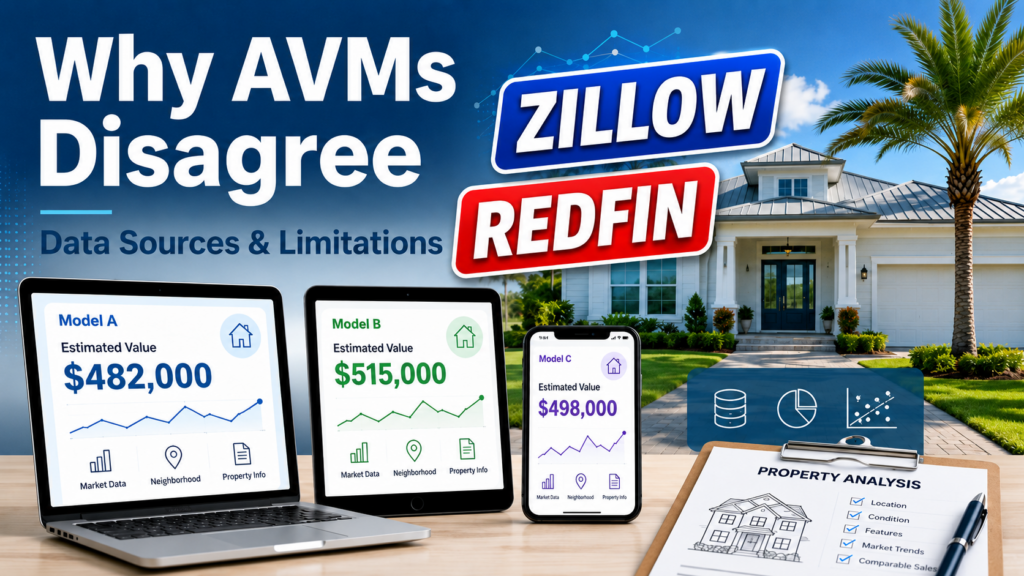
We’ve found so many property owners wondering why AVM’s like Zillow, Redfin & others disagree with each other. Automated Valuation Models, commonly called AVMs, are computer-generated estimates of a property’s value. Zillow’s Zestimate, Redfin Estimate, Realtor.com estimates, lender models, tax-based tools, and investor platforms all use different formulas to interpret sales data, public records, listing activity, and market trends.
The reason they disagree is simple: each AVM is reading a different version of the market. One might rely heavily on public records, another may pull faster from MLS activity, and another may weigh recent listings, tax data, neighborhood trends, or buyer behavior differently. Here in Florida, where waterfront influence, flood zones, insurance costs, condo reserves, HOA risks, storm mitigation, and rapid population movement can shift value block by block, those differences matter.
AVMs are significant because they influence expectations before anyone studies the property in person. A high online estimate may create overpricing, while a low estimate may cause missed equity, weaker negotiations, or unnecessary doubt. Used properly, AVMs are helpful starting points, but they are not the same as a market-supported appraisal.
What are AVMs Really Measuring?
AVMs estimate value by analyzing patterns in available data. They are fast, convenient, and useful for broad market awareness, but they are not physically inspecting the property, as an appraiser would. Common AVM inputs include:
- Public records: square footage, lot size, year built, prior sales, tax assessment history, and recorded property characteristics.
- Recent sales: nearby closed transactions that the model identifies as comparable.
- Listing activity: asking prices, price reductions, days on market, and buyer-facing market signals.
- Statistical trends: neighborhood price movement, seasonal shifts, and broader market momentum.
Insight from our Appraisal Team: AVMs are strongest when properties are standardized, data is accurate, and the neighborhood has frequent similar sales. They struggle more when the property is unique, recently renovated, poorly recorded, or located in a highly segmented Florida market.
Why Zillow, Redfin & Other AVMs Disagree
Two AVMs can look at the same house and produce different numbers because they are not using the same assumptions.
The biggest reasons include:
- Different data access: Redfin emphasizes MLS-connected data, while other platforms may rely more heavily on public records and user-submitted updates.
- Different update timing: One model may recognize a recent sale or price cut before another does.
- Different comparable selection: Algorithms may choose different “nearby” sales even when those sales are not equally comparable.
- Different treatment of uncertainty: Some platforms publish a single number, while others provide a wider value range to reflect data confidence.
Insight from our Appraisal Team: A canal-front home in Brevard County may be treated as “waterfront” by one model, while another may not fully separate canal access from riverfront, lakefront, or oceanfront influence. That can create a large value gap before anyone even considers dock condition, bridge clearance, flood risk, or insurance cost.
What AVMs Often Miss in Florida
Florida property valuation is highly local. A model may recognize the address, but miss the value story.
AVMs often struggle with:
- Insurance and flood risk: Premiums, FEMA flood zones, elevation certificates, wind mitigation, and storm exposure can affect what buyers are willing to pay.
- Condition and quality: A renovated roof, updated kitchen, impact windows, HVAC replacement, or deferred maintenance may not be visible in public data.
- Micro-location differences: Busy roads, flight paths, school zones, industrial neighbors, nightlife districts, waterfront type, and gated community influence may not be measured accurately.
- Association risk: Condo reserves, special assessments, HOA litigation, insurance increases, and financing restrictions can affect marketability and value.
Insight from our Appraisal Team: Florida values are often shaped by ownership cost, not just sale price. Two homes with the same size and bedroom count may appeal to very different buyers once insurance, HOA fees, assessments, flood risk, and maintenance exposure are factored in.
How AVM Gaps Affect Market Value
AVMs do not create market value by themselves, but they can influence how people react to the market.
Common impacts include:
- Pricing expectations: Sellers may list too high if they rely on the highest estimate instead of recent comparable sales.
- Negotiation behavior: Buyers may use a low AVM as leverage, even if the model missed upgrades or location premiums.
- Appraisal surprises: When contract prices are built around online estimates instead of market-supported comps, appraisal gaps become more likely.
- Investor decisions: Investors using AVMs alone may overestimate rent potential, resale value, or profit margins.
Insight from our Appraisal Team: AVMs are not the problem. Overreliance is the problem. The safest approach is to treat them as a screening tool, then verify with local sales, property condition, market exposure, and professional valuation support.
How to Use AVMs the Smart Way
AVMs can still be valuable when used correctly. The key is to compare the estimate against real-world evidence.
Use AVMs as follows:
- Compare multiple platforms: If Zillow, Redfin, Realtor.com, and lender tools are far apart, that is a signal to investigate—not pick the number you like best.
- Check the property facts: Confirm square footage, lot size, bedrooms, bathrooms, year built, pool, garage, waterfront status, and recent improvements.
- Review recent comparable sales: Focus on closed sales, not just active listings or online estimates.
- Document what the model cannot see: Permits, renovation receipts, insurance credits, elevation certificates, roof age, impact windows, and HOA disclosures can all help explain value.
Insight from our Appraisal Team: The best valuation conversations start with evidence. Property owners who organize accurate documentation make it easier for agents, buyers, lenders, and appraisers to understand the real value story.
When You Should Get an Appraisal Instead of Trusting an AVM
An AVM may be enough for casual curiosity, but certain situations call for a professional appraisal.
Consider an appraisal when:
- You are buying or selling: A professional valuation can reduce pricing mistakes and negotiation risk.
- The property is unique: Waterfront homes, rural properties, luxury homes, manufactured homes, mixed-use areas, and heavily renovated homes often require deeper analysis.
- You are making financial decisions: Estate planning, divorce, tax appeal, PMI removal, investment analysis, and pre-listing strategy need stronger support than an online estimate.
- The AVMs disagree widely: A large spread between platforms usually means the data is incomplete, conflicting, or difficult to interpret.
Insight from our Appraisal Team: An appraisal does what an AVM cannot: it interprets market behavior through the lens of property condition, location, quality, risk, utility, and comparable sales support.
How You Can Protect Your Property Value
Understanding AVMs helps property owners stay realistic, prepared, and strategic. Sellers can avoid overpricing based on inflated estimates. Buyers can avoid overpaying when online numbers miss market risk. Homeowners can understand whether their equity estimate is reliable. Investors can test profit assumptions before making an offer. Realtors can reduce appraisal gaps by explaining why online tools differ from real comparable sales.
In Florida, this matters even more because values are shaped by fast-changing local conditions: population growth, insurance volatility, coastal exposure, new construction, condo regulation, storm mitigation, and buyer migration patterns.
AVMs can estimate a number, but REAL VALUE comes from understanding the story behind the data. Appraisers can bring these details to the table in spades!
Ask Our Appraisers
Have you ever looked up your home online and found three completely different values? What confused you most? The number, the range, or why your improvements were not reflected?
Send us your question and it may be featured in a future newsletter.