
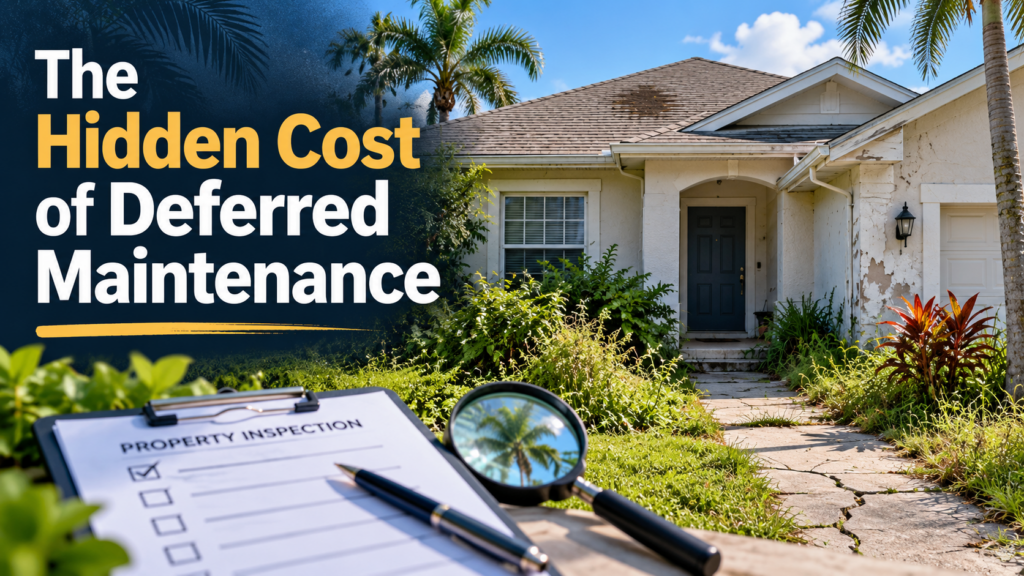
Let’s talk about what “Deferred Maintenance” 🛠️ means:
Deferred maintenance occurs when normal repairs, replacements, or property upkeep are postponed long enough for a home’s condition to begin deteriorating.
A small roof leak, damaged siding, aging HVAC system, plumbing drip, rotted wood, or neglected exterior paint may seem manageable today. But when several unresolved items accumulate, buyers, inspectors, lenders, insurers, and appraisers may begin viewing the property as having greater repair risk and weaker overall condition.
Why Does Deferred Maintenance Matter to Property Value?
Florida buyers already face significant costs for insurance, taxes, financing, repairs, and storm-related property protection. A house that appears likely to require thousands of dollars in additional work can therefore lose negotiating power against a similar move-in-ready property. The greater the uncertainty surrounding a repair, the more likely buyers are to build that uncertainty into their offers… or avoid the property completely.
Small Repairs Can Become Large Condition Problems
Deferred maintenance tends to compound. A repair that might once have been inexpensive can eventually damage additional components of the home. Consider these examples:
- A Minor Roof Leak → Interior Damage
A small leak can eventually contribute to damaged ceilings, insulation, drywall, wood components, or moisture concerns. - A Small Plumbing Leak → Larger Moisture Problems
An unresolved plumbing issue may eventually affect cabinetry, flooring, walls, or surrounding building materials. - Peeling Paint or Damaged Exterior Materials → Increased Exposure
Florida’s heat, humidity, rain, and storms can accelerate deterioration when exterior components are left unprotected.
⭐️Our Appraiser’s Insight:
The market may react very differently to one minor maintenance item than it does to a property showing evidence of widespread neglect. One repair may be ordinary ownership (from general wear & tear). Ten unresolved repairs can begin telling buyers a story about the home’s overall condition.
Condition Can Change How Your Home Competes With Comparable Sales
Appraisers don’t simply ask: “How much will these repairs cost?”
We also ask: “How is the market reacting to properties in this condition?”
We Look At Things Like:
- Condition Differences Between Comparable Homes
Are renovated or well-maintained properties consistently selling above homes requiring repairs? - Buyer Reaction
Do properties with deferred maintenance experience longer marketing times, price reductions, concessions, or weaker offers? - Overall Condition Rating
Appraisal standards distinguish normal wear and minor repairs from more substantial deferred maintenance.
A home can therefore have the same square footage, bedroom count, lot size, and general location as another property… and still sell differently because of condition and perceived future repair costs.
⭐️Our Appraiser’s Insight:
Repair cost ≠ value adjustment.
Instead: Deferred Maintenance → Buyer Reaction → Comparable Sales → Market-Supported Value Impact
Appraisals and Home Inspections Are Looking at Different Things
This distinction is important.
A home inspector evaluates accessible systems and components to provide an opinion regarding the property’s physical condition.
An appraiser develops an opinion of value while also observing and reporting conditions that may affect the property’s condition, marketability, safety, soundness, or structural integrity. That means:
- An Inspection Can Identify Problems That Affect Negotiations
An inspection report may result in repair requests, credits, contract renegotiations, or further specialist inspections. - An Appraisal Can Reflect Market Reaction to Condition
If similar properties needing repairs consistently sell below well-maintained competitors, that difference may become part of the valuation analysis. - Some Problems Can Affect Financing
Conditions affecting safety, soundness, or structural integrity may require additional inspection or repair before certain mortgage transactions can proceed.
⭐️Our Appraiser’s Insight:
An appraiser is *not performing a home inspection. *However, visible deficiencies cannot simply be ignored when they affect the property’s value, condition, or marketability.
The Biggest Financial Risk May Be Buyer Uncertainty
Sometimes the problem isn’t the repair itself. It’s the question: “What else is wrong?” When buyers see several maintenance issues, they may assume additional problems exist behind the walls, under the roof, or within aging systems. That uncertainty can lead to:
- *Lower Offers – *Buyers may leave themselves a financial cushion for repairs they cannot precisely estimate.
- *Repair Credits and Concessions – *Inspection findings can become negotiating tools before closing.
- *A Smaller Buyer Pool – *Buyers seeking move-in-ready homes might eliminate the property altogether.
⭐️Our Appraiser’s Insight:
A $2,000 visible problem does not necessarily produce a $2,000 market reaction.
The buyer may be pricing the repair plus uncertainty, inconvenience, contractor risks, and additional future work. That is why maintenance problems can sometimes create a disproportionately large marketability problem.
Florida 🌴Makes Maintenance Especially Important
Florida homes operate in a demanding environment. Heat, humidity, heavy rainfall, wind exposure, salt air in coastal areas, insects, and tropical weather can accelerate deterioration. Three areas deserve particular attention:
- Roof Condition – Roof age and remaining useful life can affect not only buyer perception but insurance eligibility and ownership costs. Florida’s Citizens Property Insurance, for example, applies roof-age underwriting requirements and may require documentation concerning replacement or remaining useful life for older roofs.
- Moisture & Water Intrusion – Evidence of leaks, dampness, deterioration, or moisture can trigger additional scrutiny because unresolved water intrusion can affect multiple building components.
- HVAC, Electrical & Plumbing Systems – Older or poorly maintained systems can increase anticipated ownership expenses and, when significant deficiencies exist, may also create financing concerns.
⭐️Our Appraiser’s Insight:
In Florida, maintenance is increasingly connected to affordability. Buyers aren’t simply asking: “What does this home cost?” They’re asking: “What will this home cost me after I own it?”
Deferred Maintenance Can Affect Rental and Investment Performance Too 💰
Maintenance problems do not disappear simply because a property is income-producing. They become operating expenses. Deferred maintenance can:
- Increase Future Capital Expenditures – Postponing replacement of roofs, HVAC systems, plumbing, exterior components, or other improvements can create larger future cash requirements.
- Reduce Tenant Appeal – Poorly maintained properties may compete less effectively with updated rental inventory.
- Reduce Resale Flexibility – An investor eventually selling the property may face the same condition-related resistance from future buyers.
⭐️Our Appraiser’s Insight:
Strong rental income is valuable… but investors should evaluate net income after realistic maintenance and replacement expenses, not rent alone.
How Can YOU Protect Your Property’s Marketability?
The goal isn’t to renovate everything before an appraisal. It’s to prevent manageable maintenance from becoming measurable deterioration. Start with these 3 steps:
- Fix Active Problems First – Prioritize water intrusion, active leaks, damaged roofing, electrical issues, plumbing problems, wood deterioration, and safety concerns.
- Maintain the Major Systems – Document roof work, HVAC servicing, plumbing repairs, electrical updates, exterior maintenance, and other significant improvements.
- Keep Records – Permits, invoices, contractor receipts, warranties, photographs, and repair documentation can help establish what has been completed and when.
Don’t confuse maintenance with remodeling. Replacing a failed component and installing a luxury upgrade are not the same thing. Maintenance protects existing utility and marketability. Renovation may add contributory value… but only when buyers demonstrate that they will pay for it.
How Do Appraisers Analyze Deferred Maintenance?
When condition issues are present, we generally consider the following:
- Comparable Sales – We compare properties with similar condition levels whenever credible sales are available.
- Market Reaction – We examine sales prices, concessions, marketing time, condition differences, and buyer behavior.
- Severity of the Deficiency – Minor wear and tear is very different from conditions affecting safety, soundness, structural integrity, or basic property functionality.
We don’t automatically subtract contractor estimates from the appraised value. The market (not the repair invoice) ultimately tells us how much the condition matters.
Here’s the Bottom Line…
Deferred maintenance is rarely just about the cost of one repair. Small unresolved problems can accumulate into greater buyer uncertainty, inspection negotiations, insurance or financing complications, weaker marketability, and ultimately a measurable difference in property value. The least expensive repair is often the one handled before buyers, inspectors, insurers, and appraisers start pricing the consequences of waiting.
Ask Our Appraisers
What real estate policy change are you most concerned about right now? (Insurance, flood zones, mortgage rules, HOA/condo regulations, or new development?)
Your question may inspire a future newsletter topic.
Visit www.redefinevalue.com to learn more about our appraisal services, explore more from our blog right here: https://redefinevalue.com/blog-page/, and connect with us for real estate valuation insights across Florida’s Space Coast and beyond.
Follow us on YouTube, Facebook, and Instagram for more appraisal education, market insights, and property value tips.